
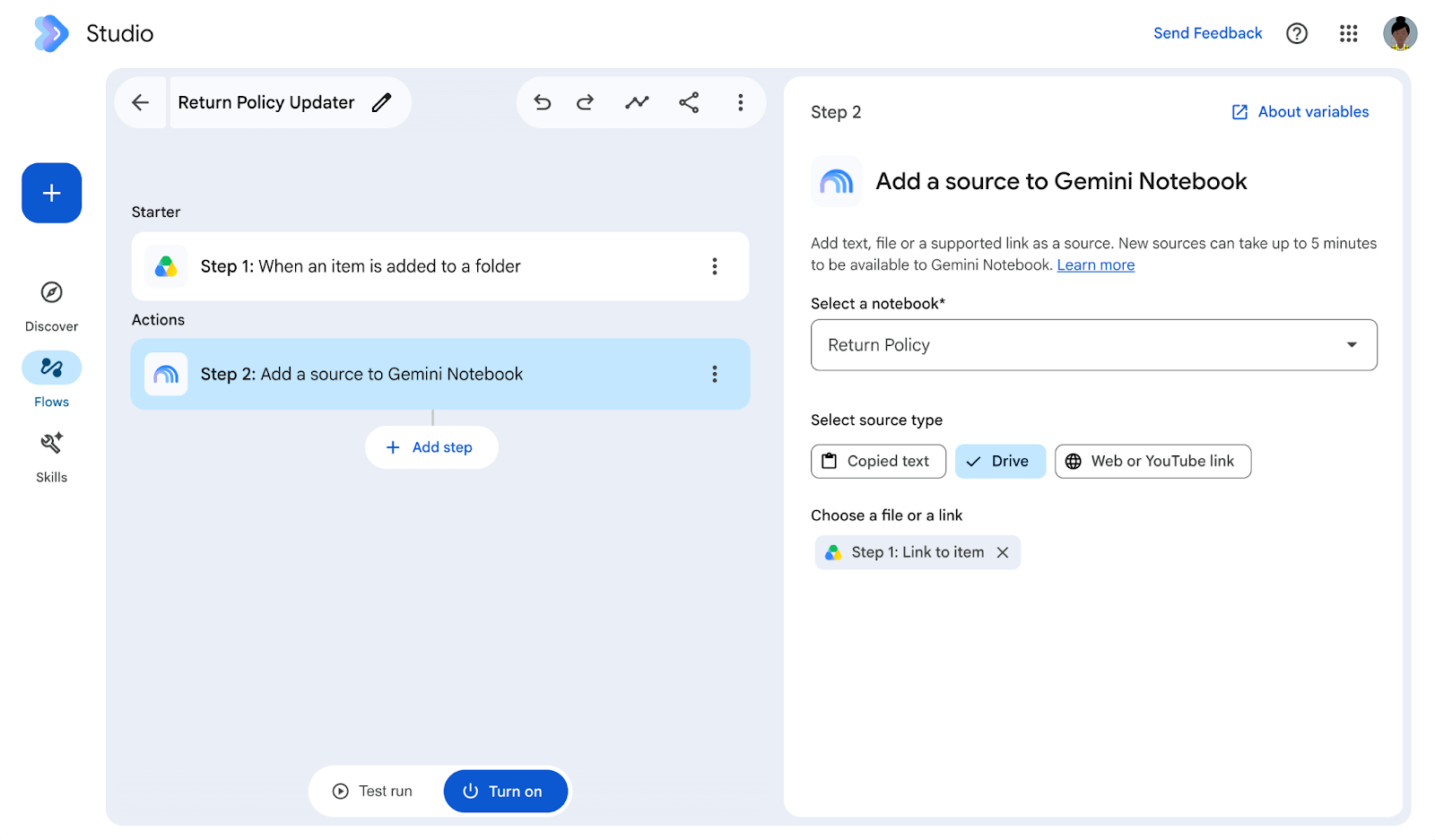
Google has officially introduced a new automation feature for Gemini Notebooks within the Google Workspace Studio platform. Announced on August 7, 2026, this update aims to streamline how users manage their information by removing the need for manual data entry. This announcement is significant because it integrates advanced AI workflows directly into the daily productivity tools used by millions of professionals worldwide, marking a major step forward in automated content management.
The primary feature of this update is the “Add a source to Gemini Notebook” step, which allows users to automatically ingest various types of data into their AI-powered notebooks. Unlike the previous manual method where each source had to be added individually, this new integration supports a wide range of inputs including plain text, Google Drive files, and even external web or YouTube links. The goal of this feature is to ensure that AI models always have access to the most current information without requiring constant human intervention.
Technologically, this implementation is built into the Workspace Studio environment and is available by default for administrators who have enabled Gemini for Google Workspace. The rollout began on August 6, 2026, for both Rapid and Scheduled Release domains, with a gradual visibility period of up to fifteen business days. Target users include subscribers of Business Starter, Enterprise Standard, and various Education editions, ensuring that students and professionals alike can benefit from these enhanced AI capabilities.
This expansion is expected to significantly reduce the time users spend on administrative tasks, allowing them to focus more on analysis and creative work. For the broader industry, it sets a new benchmark for how generative AI can be integrated into enterprise workflows through seamless background automation. As a next step, Google will likely continue to expand the types of supported sources and further refine the accuracy of AI-generated insights based on these dynamically updated notebooks.
Source: Google blog