
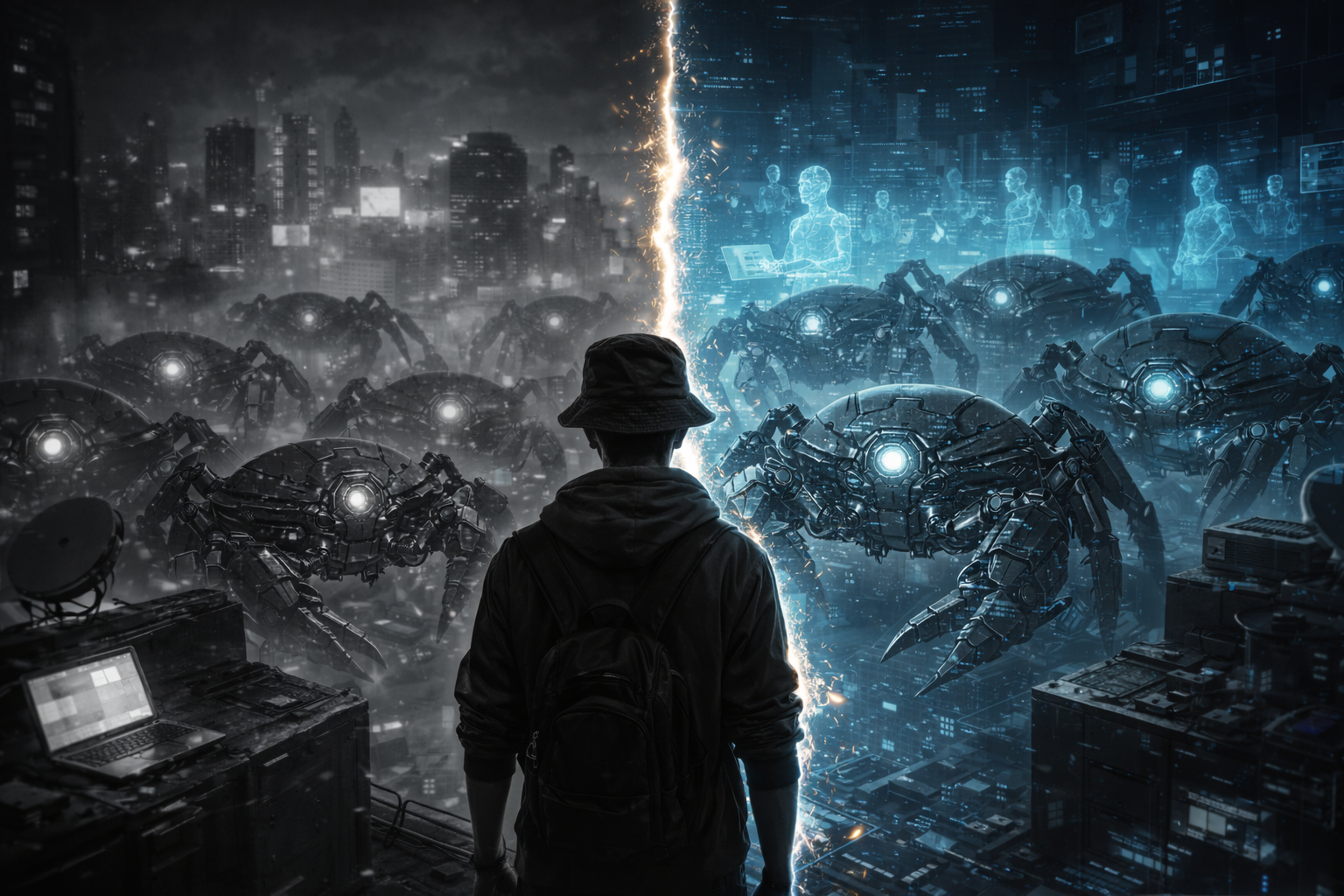
Today internet is no longer one-dimensional. It has split—or rather evolved—into two main entities: real humans and AI agents. If the internet once served purely as a space for human-to-human interaction, much of today’s digital activity now involves non-human entities capable of thinking, responding, and even making decisions. From customer service chatbots and trading bots to AI content creators, the internet has become a living hybrid ecosystem.
Humans remain the primary source of value: emotion, intuition, lived experience, and social context. AI agents, however, act as accelerators—fast, consistent, and tireless. They can operate 24/7, analyze massive amounts of data, and handle repetitive tasks that once drained human energy. At this point, the internet is no longer just a tool, but a collaborative space between biological intelligence and artificial intelligence.
Interestingly, the boundary between humans and AI agents online is becoming increasingly blurred. Many digital interactions no longer make it clear whether we are communicating with a real person or an AI. Across social media, forums, marketplaces, and customer support platforms, AI agents are beginning to develop their own “digital identities.” This raises new questions around trust, ethics, and transparency—who is really behind the screen?
Looking ahead, the internet is unlikely to choose one over the other. Humans and AI agents will continue to coexist, forming a new kind of symbiosis. Humans define direction, values, and meaning, while AI agents execute and scale those intentions. These two dimensions are not threats to each other, but the foundation of the next era of the internet—where intelligence is no longer about who is alive, but who can adapt.