
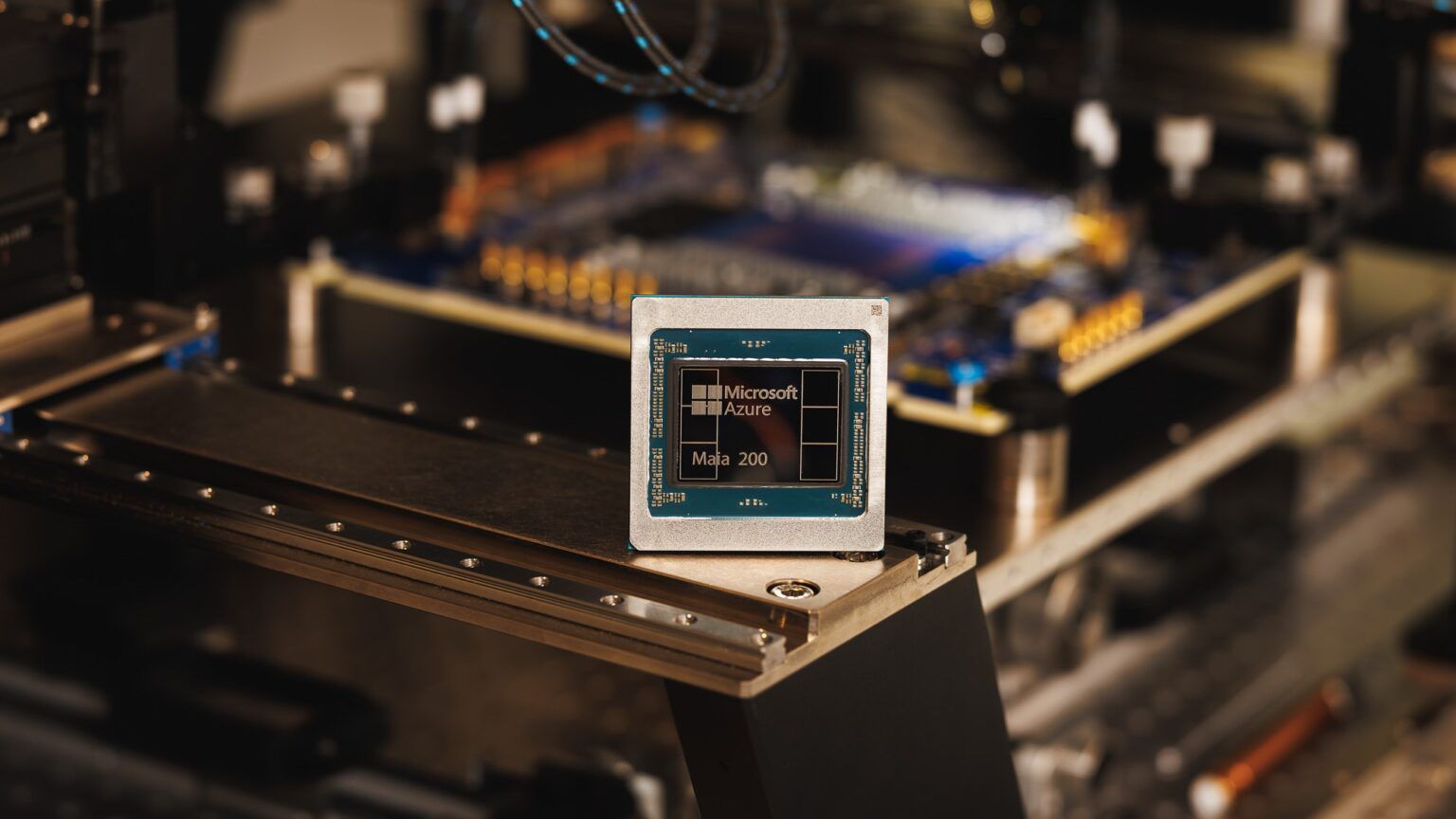
Microsoft has once again made waves in the artificial intelligence landscape with the introduction of Maia 200, a next-generation AI accelerator chip designed specifically for inference—the stage where AI models process inputs and generate responses for users. Built on TSMC’s advanced 3-nanometer process, Maia 200 combines thousands of FP8 and FP4 tensor cores with a large-capacity memory system, enabling it to handle highly complex AI models efficiently.
This design allows the chip to deliver strong performance while keeping operational costs under control compared to many existing AI hardware solutions. From a performance standpoint, Maia 200 demonstrates competitive advantages over major rivals from companies such as Amazon and Google. Its FP4 performance is reported to be up to three times higher than third-generation Trainium chips, while its FP8 capabilities surpass those of Google’s latest TPU generation. These gains make Maia 200 particularly well-suited for large-scale generative AI workloads, including services running within Microsoft’s AI platforms such as Azure Foundry and Copilot.
Cost efficiency is another key highlight of Maia 200. Microsoft states that the new system delivers roughly a 30% improvement in performance per dollar over previous hardware generations. This means enterprises and developers can deploy advanced AI models with lower operating expenses. Optimized memory integration and an improved internal architecture further reduce latency and minimize the need for additional supporting hardware.
Deployment of Maia 200 has already begun across Microsoft’s data centers in regions such as Iowa and Arizona, with broader expansion planned. To support adoption, Microsoft is also providing a comprehensive software development kit, including compatibility with frameworks like PyTorch and the Triton compiler. Through Maia 200, Microsoft reinforces its long-term strategy to strengthen its AI infrastructure while reducing dependence on third-party accelerator chips.
Source: Microsoft Blog